


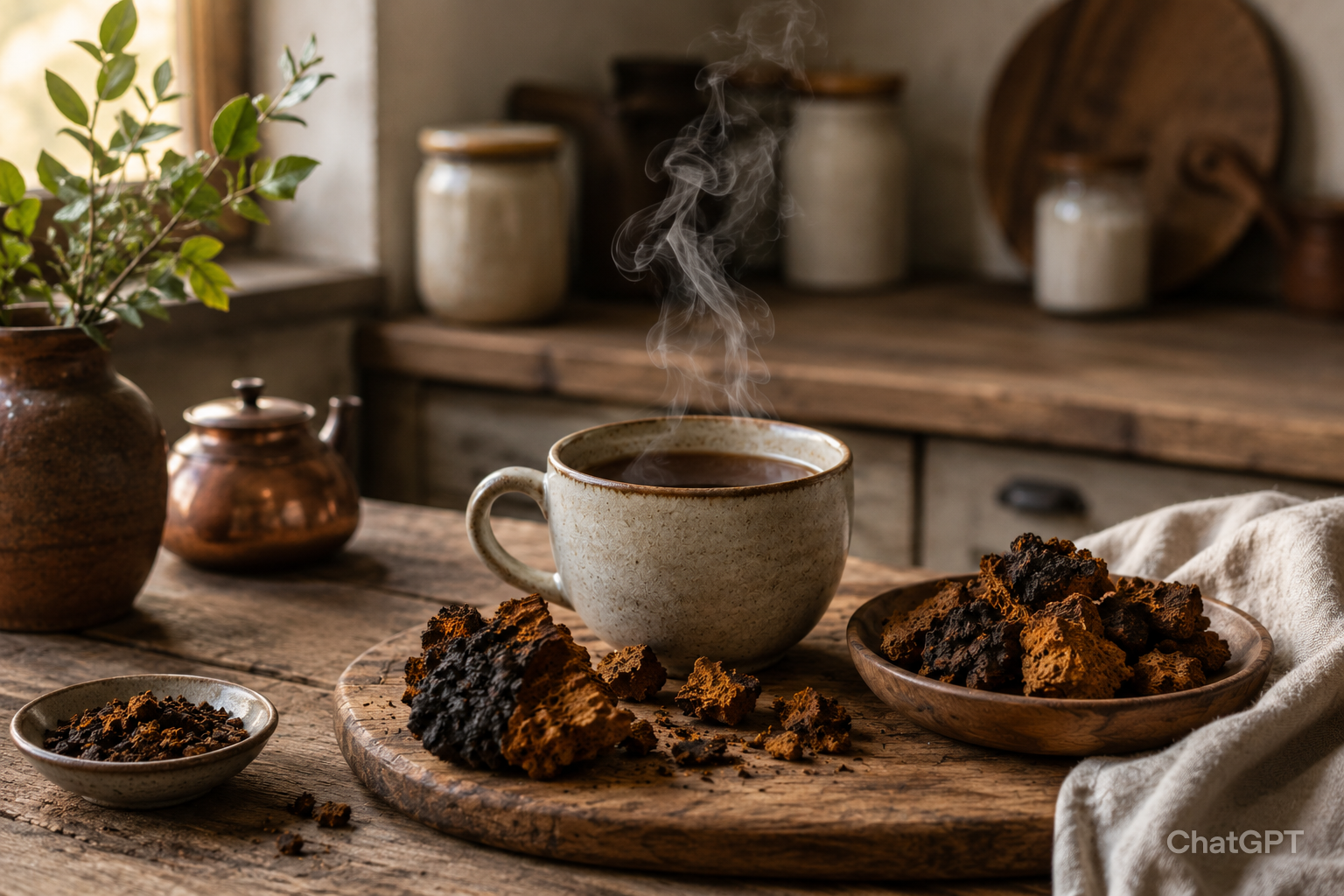
Chaga is a mushroom with over 5,000 years of documented traditional use across Siberia, Asia and beyond. Rich in antioxidants, beta-glucans and essential minerals, it is widely regarded as one of the most nutritionally dense fungi on the planet. Known as the king of herbs, it has earned its place as a cornerstone of natural health traditions worldwide.
🌲 What is Chaga?
Scientifically known as Inonotus obliquus, Chaga is a parasitic fungus that eats its host tree from the inside out over a long period of up to eighty years. Predominantly growing on birch trees in cold climates, specifically regions such as Siberia, Scandinavia, and North America. It appears as big black growths on their host trees, rough and bumpy with cracked and irregular surfaces. Underneath this exterior, a rich golden orangey-brown interior can be found, and this is where the health benefits can be discovered.
📜 A Brief History of Chaga
Ancient Origins
Chaga's medicinal benefits have been known for so long, no one can clearly say who the first people to use it were. But in 1991 a well-preserved mummy was discovered in the Austrian Alps; named Otzi the Iceman and over 5,300 years old, he was found to be carrying Chaga in his pouch.
Nearly 4,000 years ago, as far back as 2696 BC, Shen Nong - said to be the father of Chinese Medicine - is thought to have dubbed the mushroom with its title as "the king of herbs."
The Khanty People of Siberia
In Siberian folklore, it was named as a "Gift from God" or "The Mushroom of Immortality" and its most well-recorded initial historical usage can be found with the Khanty people of Western Siberia. As far back as the 12th century, they were known to have made tea out of the mushroom, with the idea it might boost energy and stave off hunger during wild moose hunts. They then drank the tea again upon feasting, so that it might aid their digestion afterwards.
But their use of the mushroom did not end there: as well as using it internally, they also found external uses for Chaga too. These methods ranged from putting the conks through fire, then placing the heated mass into hot water before using the water to purify and clean the vagina after menstruation and birth-giving; to mixing the mushroom with lard and ash in order to create a soap with which to clean wounds. They even went as far as to smoke the mushroom in an attempt to improve their lung health - a method which is not recommended anymore!
Chaga in Modern Times
In more recent times, the acclaimed Russian author and Nobel Laureate, Alexander Solzhenitsyn, wrote about his desire to find the mushroom in his famous 1968 novel. Not expected to survive his prognosis of disease, he sought further aid in his treatment and, having heard about it in a letter from his doctor, turned to the old folklore of his country. The doctor told him that he had noticed his peasant patients avoided coming down with certain maladies and looked into what might be separating them from others - the answer seemed to be Chaga. So, managing to get his hands on some, the protagonist of the novel takes the fungus studiously alongside his hospital treatment and does indeed make a "miraculous" recovery by the end of the story.
✨ Why Chaga? The Health Benefits
Chaga is also one of the most well-known adaptogens, and Chaga is also one of the most well-known adaptogens, working on the HPA axis - the body's central system for managing the stress response.
Chaga is rich in fibre and many essential nutrients such as iron, magnesium, potassium, manganese, calcium, and vitamin D. It is also high in antioxidants, including melanin, phenol, and flavonoids. Chaga contains exceptionally high levels of superoxide dismutase (SOD), a powerful antioxidant enzyme. Due to its exceptionally high antioxidant content, it can help to combat oxidative stress and protect against free radical damage to cells.
🛒 How to Take Chaga
Chaga can be consumed and used in a variety of different ways. We find the most economical and effective way of consuming it is in extract form - just half a teaspoon is needed to create a brilliant coffee alternative.
Tinctures are convenient and easily portable consumption methods for those wanting to take their Chaga on the go. As a versatile and adaptive herb, we also have many blends containing it available.
🍫 What Pairs Well With Chaga?
Chaga can also work great in conjunction with other adaptogenic mushrooms, such as lion's mane or reishi, where the effects can double up. Four Sigmatic do some great coffee and mushroom blends, such as Chaga with Reishi or Chaga with Cordyceps both of which are popular combinations. It's also worthwhile buying the mushrooms separately and experimenting with finding which combinations work best for you.
Anima Mundi Herbals also do a few excellent mushroom blends, from the delicious Mushroom Mocha Milk, to the convenient Adaptogenic Tonic - both containing seven adaptogens. You can see all their Chaga products here.
Another great pairing is with a superfood like cacao. The rich, complex flavour profile of cacao provides a natural synergy with chaga's adaptogenic properties. Ancient + Brave do a delicious blend, which you can find here.
A full list of Raw Living's Chaga products can be found here.
❓ Chaga FAQs
Q: Is chaga safe to take every day? A: Chaga is widely considered safe for daily use and has been consumed as a daily tonic in Siberian and Eastern European traditions for centuries. As with any supplement, it is best to start with a smaller amount and build gradually. Those on blood-thinning medications or immunosuppressants should consult a healthcare practitioner before use.
Q: What does chaga taste like? A: Chaga has a mild, earthy flavour with subtle notes of vanilla and a slight bitterness - closer to a smooth, dark tea than a typical mushroom. Most people find it very easy to drink, which is part of what makes it such a popular coffee alternative. It pairs particularly well with cacao, cinnamon and other warming spices.
Q: What's the difference between chaga powder, tincture and extract? A: Whole chaga powder contains the full spectrum of the mushroom's compounds but requires hot water to release the active constituents. A dual extract - processed using both hot water and alcohol — draws out a broader range of beneficial compounds and is generally considered the most potent and bioavailable form. Tinctures offer a convenient, concentrated liquid option that is easy to take on the go.
Q: What makes chaga such a popular antioxidant supplement? A: Chaga contains exceptionally high levels of antioxidants including superoxide dismutase, phenols and flavonoids, which help to combat oxidative stress and protect against free radical damage to cells. It has been used traditionally for centuries across Siberia and Eastern Europe as a daily tonic, and is one of the reasons it remains one of the most widely consumed medicinal mushrooms in the world. As always, it works best as part of a balanced diet and healthy lifestyle.
Q: Where does the best quality chaga come from? A: The finest chaga is generally considered to come from wild-harvested sources in Siberia and other cold northern climates, where slow growth on mature birch trees produces the most nutrient-dense mushroom. Sustainably harvested wild chaga is preferable to cultivated varieties, which tend to have a lower concentration of the key active compounds. Always look for products that clearly state their sourcing and harvesting methods.
Browse our full range of Chaga products at Raw Living →


