


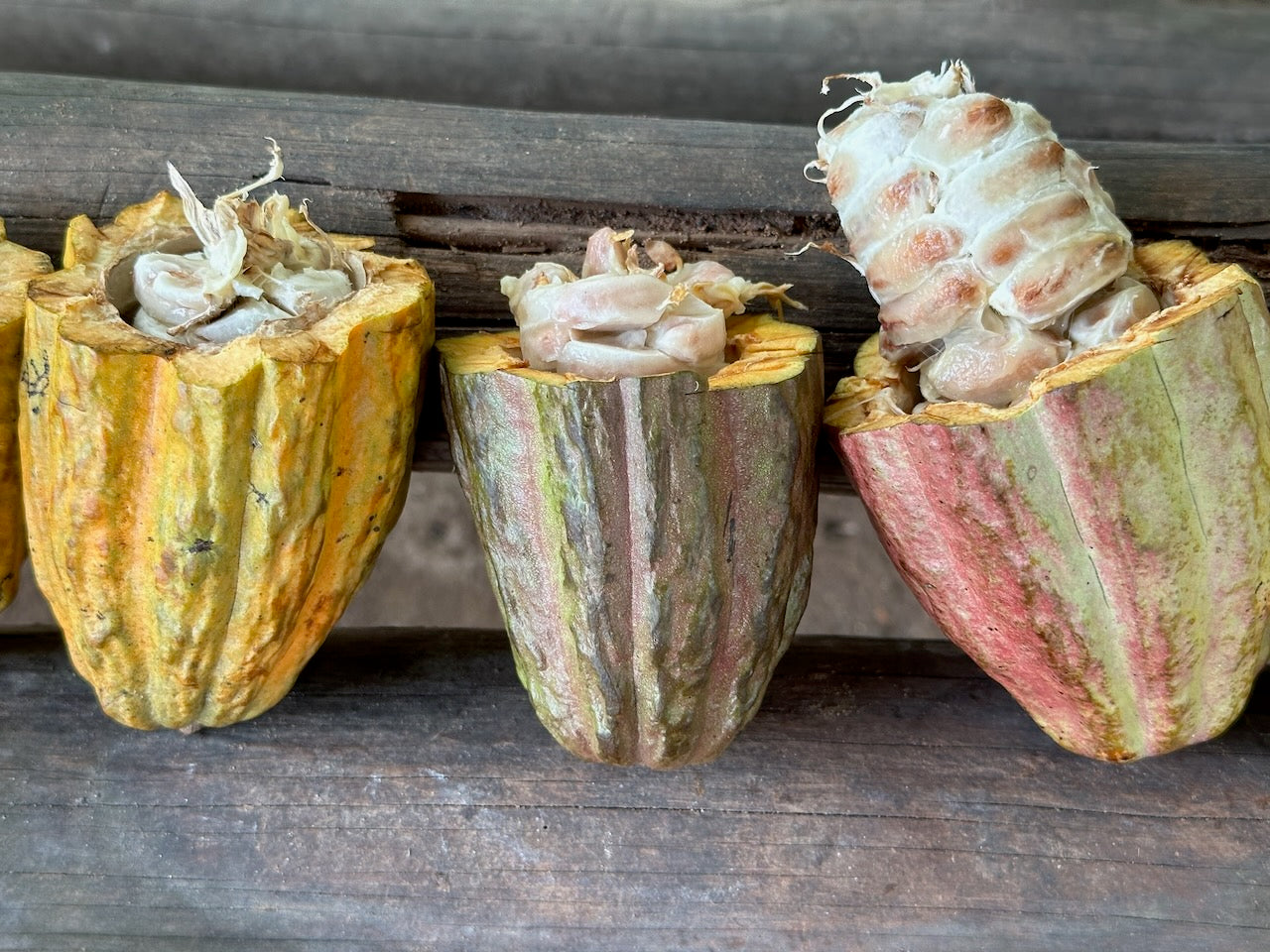
Raw cacao is one of nature's most extraordinary superfoods — rich in antioxidants, magnesium, and mood-boosting compounds. At Raw Living, we stock a full range of organic, minimally processed raw cacao products sourced directly from small Peruvian farming cooperatives, including cacao nibs, cacao powder, cacao butter, cacao paste, and ceremonial grade cacao. Whether you're making your own raw chocolate at home or looking for the easiest way to add cacao to your daily routine, this guide covers everything you need to know.
🌍 At Raw Living, Cacao is a Way of Life
At Raw Living, cacao isn't just a product — it's a passion. We've been consuming it almost daily for over twenty years, and our love for it shows no signs of slowing down. We were first introduced to raw cacao beans by David Wolfe back in 2004, and since then we've spent two decades buying, selling, eating, making, researching, and just generally celebrating everything cacao. In 2024, Kate travelled to Peru to meet the farmers behind our beans — a truly remarkable experience you can read about here and in her ebook, Adventures in Peru.
🌎 Where Does Cacao Come From?
Cacao only grows within a narrow tropical band known as the "cacao belt" — roughly 20 degrees either side of the equator, where the hot, humid conditions the cacao plant loves are found year-round. Peru, Ecuador, Costa Rica, Bali and Hawaii all sit within this belt, as does much of Southeast Asia. Cacao was first introduced to Africa via the islands of São Tomé and Príncipe in the late 1800s, and today West Africa grows around 70% of the world's cacao — with Ivory Coast and Ghana alone accounting for the majority of that.
It's important to understand the history behind this shift. Slavery in cacao production began in South America and the Caribbean, where European colonisers used enslaved African labour to work their plantations. As slavery was abolished across Latin America in the 19th century, production was deliberately moved to Africa, where forced labour was still available. That colonial legacy of exploitation hasn't entirely disappeared — child labour and modern slavery remain serious issues in West African cacao supply chains today. If you want to enjoy cacao that is rooted in a cleaner, fairer history, sourcing from South America — where cacao originated — is the most meaningful choice you can make.
✨ Why Our Cacao is Different
At Raw Living, we work closely with a small cooperative of Peruvian farmers who produce certified organic cacao using minimal temperature processing — and it's worth emphasising just how rare this is. Even within South America, the majority of cacao is not organic; gaining certification in these remote, rural regions is a lengthy and expensive process that most small farmers simply can't access. And while Peru and Ecuador produce some of the finest cacao in the world, the vast majority of it is still heat-treated during processing, because higher temperatures make the whole operation faster, cheaper, and easier to scale.
What we offer is something genuinely different — truly raw, organic cacao that has been handled with care at every stage, preserving the full spectrum of nutrients, enzymes, and flavour that makes it so special.
🍦 The Different Types of Raw Cacao Product
🌰 Cacao Beans: The Beginning of Everything
Think of the cacao bean as the seed of a fruit. Cacao pods are filled with a white, creamy pulp surrounding many seeds — it's these seeds that eventually become everything we know and love about chocolate. Once harvested, the beans are typically fermented in the sun and then roasted, and are sold either with or without their skins.
We used to stock cacao beans at Raw Living but found they weren't as popular as our other products — however if you do come across them elsewhere, they make a wonderful snack eaten with a drizzle of honey or yacon syrup!
🍫 Cacao Nibs UK: The Snackable Superfood
Cacao nibs are simply the cacao bean broken down into smaller pieces — think of them like chopped almonds. They're one of the most versatile raw cacao products you can have in your kitchen, and once you start adding them to things, you'll wonder how you ever managed without them.
Sprinkle them over a smoothie bowl or granola, toss them into a trail mix, or grind them up to make your own raw chocolate at home. But don't stop there — cacao nibs work beautifully in savoury cooking too. Try scattering them over a salad, or adding them to dishes with tomato and chilli. Think mole — that rich, complex Mexican sauce where cacao and chilli were always meant to be together. 🌶️
🍫 Cacao Paste, Cacao Liquor & Ceremonial Cacao: The Chocolate Maker's Essential
Cacao paste and cacao liquor are simply two names for the same product — the whole cacao bean ground down into a paste. It's dense, rich, and intensely chocolatey, and is best used for making your own raw chocolate creations at home.
It's also worth addressing ceremonial grade cacao here, as this term has become increasingly popular — and increasingly misused. Ceremonial grade has become a widely used label for raw cacao paste, but the truth is that most products sold under this name are no different from a good quality raw cacao paste. True ceremonial grade cacao has been blessed by indigenous priests in the region where it is grown — typically Ecuador or Peru — as part of a long spiritual tradition.
We do stock some truly ceremonial grade cacao here at Raw Living, and if that lineage and intention matters to you, it's worth seeking out. But if you're simply looking for a paste to use in your own at-home cacao ceremony, our raw cacao liquor will serve you beautifully. We also offer our Ceremonial Bar, which has been blended with spices to make your own cacao ritual even easier to prepare.
🫓 From Paste to Powder & Butter
To get to the next stage, the cacao paste is separated into two products — cacao butter and cacao powder. Put the two back together and you essentially have the whole bean again. The cacao butter is the fat with the solids removed; the cacao powder is the solids with the fat removed.
🪴 Raw Cacao Butter: The Purest Cacao Fat
Cacao butter is a wonderful option for anyone who has a sensitivity to cacao, as none of the stimulating substances remain in the fat. It's also a joy to use in the kitchen — perfect for making your own fudges, sweets, and cakes. You'll find plenty of inspiration in Kate's books Raw Magic and The Magic Kitchen. And it's not just for eating — try rubbing it directly onto your skin, or drop a chunk into a warm bath for the most aromatic cacao soak! 🛁
☕ Organic Cacao Powder: The Everyday Essential
Cacao powder is currently the most popular form of cacao, and the easiest to use — simply spoon it into hot or cold drinks and desserts for an intense chocolatey hit.
It's worth being honest about something here, though. To our knowledge, there is currently no such thing as truly raw cacao powder on the market. When a product is labelled raw, it simply means it has been made from unroasted beans — but that doesn't mean it has been processed at low temperatures.
Part of the issue comes down to EU regulations on cadmium. Peruvian soil is naturally high in cadmium due to its volcanic nature, and when cacao is concentrated into powder, the cadmium level in the solids rises significantly — often above the EU legal limit of 0.60 mg/kg. This means that the small-scale Peruvian producers who were once making traditionally processed cacao powder are no longer able to sell their product in Europe.
🍫 Just Here for the Chocolate? We've Got You Covered!
If all of this feels like more than you bargained for and you just want to dive straight into something delicious, we've got you covered there too. We make six amazing raw chocolate bars, and our newest addition is our Magic Buttons — raw chocolate buttons that are as snackable as they sound. We also offer Tonic Power, Hi-Trail, and Magic Mix.
And if you'd like to try making your own raw chocolate at home, Kate has put together a step-by-step video guide.
As well as our own Raw Living range, we also stock brands we believe in, including Paccari and Anima Mundi Herbals.
🏆 Independently Rated: One of the UK's most ethical chocolate brands
We're proud to share that Raw Living has been independently rated by the Good Shopping Guide in their 2026 Ethical Chocolate Comparison. We came 3rd in the UK, scoring 92 out of 100 against an industry benchmark of 70.
View the Ethical Chocolate Shopping Guide here.
❓ Your Cacao Questions Answered
Q: What's the difference between cacao and cocoa?
Cacao is minimally processed and retains more nutrients. Cocoa is roasted and often alkalised, which reduces nutritional value.
Q: Cacao Paste vs Cacao Liquor — what's the difference?
They are exactly the same thing — just two names for the same product.
Q: Which cacao product is best for making raw chocolate?
Cacao paste or liquor forms the base, combined with cacao butter and a sweetener.
Q: Are cacao nibs the same as chocolate chips?
No — cacao nibs are pure crushed cacao beans with no additives.
Q: Is cacao butter safe for sensitive people?
Yes — it contains none of the stimulating compounds found in cacao solids.
Q: What does organic cacao mean?
It means grown without synthetic chemicals and often reflects small-scale farming practices.
🍫 Explore More
Ready to explore? Browse our complete cacao collection and find your perfect match 🍫


